
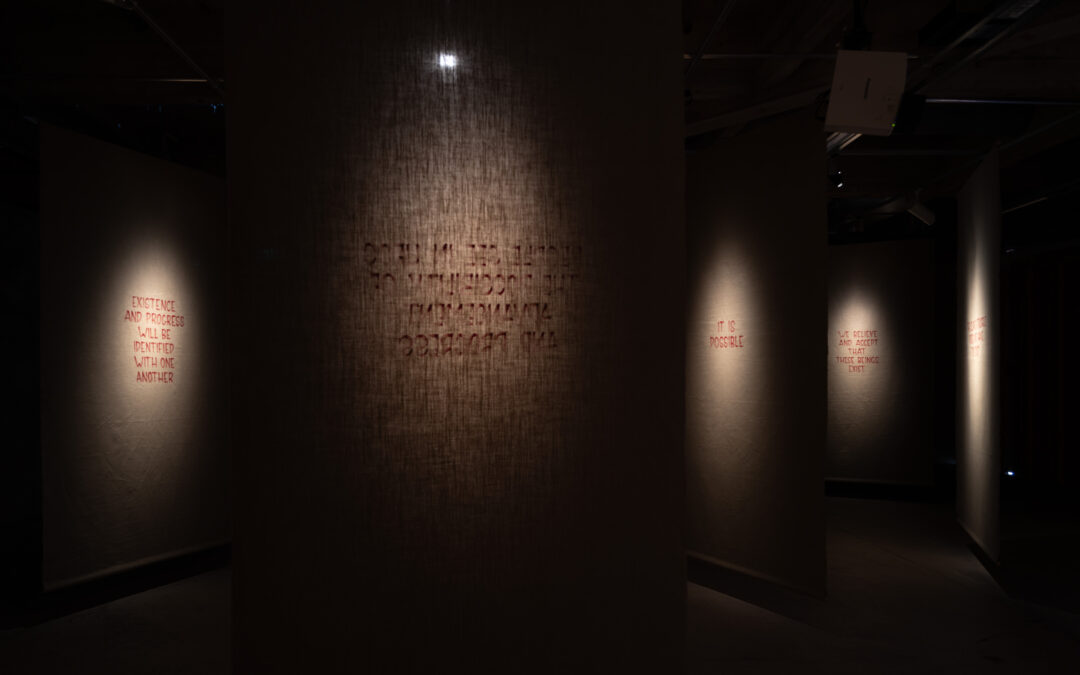
Axel Straschnoy, We Believe and Accept that These Beings Exist, installation view at EMMA-Espoo Museum of Modern Art, April-August 2026.
Axel Straschnoy
We Believe and Accept that These Beings Exist
Text by Charles Esche
Opening on Thursday, October 1st, 2026, 7-9pm.
WIZARD LAB is pleased to present Axel Straschnoy’s solo exhibition We Believe and Accept that These Beings Exist, with a text by Charles Esche.
This project was developed as part of the Fine Arts Academy of Finland Foundation Prize 2025 for EMMA – Espoo Museum of Modern Art, where it was on view from 15 April to 9 August 2026. At WIZARD LAB, Straschnoy will present a selection of works from the museum exhibition alongside certain pieces which have never been seen before.
The text by J. Posadas (born Homero Rómulo Cristalli Frasnelli, Argentina, 1912–Rome, 1981), an Argentine Trotskyist leader that influences this project, is a speech delivered in 1968, later published in French by his own press. In it, Posadas affirmed that UFOs were not only real but also the civilisations behind them must be communist. What might seem like an eccentric digression was, in fact, a continuation of Trotskyist reasoning: a belief in the historical inevitability of socialism, projected beyond the Earth. Posadas mobilised the figure of the extraterrestrial not as a fantasy but as political proof, a demonstration that communism was both possible and necessary. In this sense, the speech condenses the utopian and apocalyptic energies of the late 1960s: the threat of nuclear war, the hope of world revolution, and the persistence of imagining futures that break radically from the present.
The installation at WIZARD LAB brings together large, hand-lettered linen banners as well as framed texts on paper quoting Posadas’ speech, followed by a video showing interviews with Trotskyist activists, historians, SETI scientists, and UFO contactees.
We Believe and Accept that These Beings Exist is an artistic inquiry into the strange and fertile space where revolutionary politics, science fiction, and cosmic imagination meet. Posada’s leap of thought—absurd, visionary, and deeply political—provides a lens to consider how utopian desire extends beyond Earth.
The project does not seek to retell history in a straightforward documentary mode. Instead, it explores how belief and imagination shape our capacity to envision radically different futures. At its core, the work asks what it means to believe: to believe in aliens, in utopia, and in the possibility of a post-capitalist society. It examines how the radical hopes of one political movement might resonate again in today’s climate of ecological collapse, authoritarian resurgence, and a pervasive sense of crisis.
As Charles Esche proposes in his text for this show: “And it [the reintroduction of a utopian dimension] points at what makes Posadas available to us now. He is not substituting faith for politics. He is asserting that scientific capacity and social organisation are a single thing, which is what one of the banners says outright. That proposition needs to be legible as art in 2026 precisely because it is no longer legible as politics. We can hang it, light it and walk among it because nothing it proposed is on the table any more in the crude debates about migration and climate change denial that pass for 21st century politics. I suspect the aesthetic availability of Posadism is a direct function of its defeat but also the route to its reinvention.”
We Believe and Accept that These Beings Exist is not about nostalgia but about continuity: how forgotten radical dreams might still spark imagination in our present. It invites the viewer to look back at a moment when politics reached for the stars, not to escape Earth, as it is the case sometimes today, but to demand another way of living upon it.
Axel Straschnoy is a visual artist from Buenos Aires, currently based in Helsinki. His work explores social practices within science and art through different media. Collaboration plays an important role in his practice, as he engages with different spaces and ways to frame interactions between artworks and audiences. With an interest in expeditions of all kinds—both literal and metaphorical, scientific and artistic—his research spans films for planetariums, performances, cinematic installations, editions, traveling exhibitions, museum collections, and VR films.
Straschnoy has participated in Le Pavillon residency at Palais de Tokyo (2008-09) and studied Art History at the University of Buenos Aires.
Recent exhibitions include We believe and accept these that beings exist, EMMA – Espoo Museum of Modern Art, 2026; Towards Space, Turku Art Museum, 2025; 18 Minutes from the Sun, Museo de Arte Moderno, Buenos Aires, 2023; Subterranean, Amos Rex, Helsinki, 2022; Nanocosmic Investigations, Inter Arts Center, Malmö, 2022; The Devils of Paasselkä, Forumbox, Helsinki, 2022; The Permian Extinction, the Turku Museum in Turku, 2021; Lights in the Landscape, the Pippulhalli Museum in Savonranta, 2021; Float, Andrée Polarcenter Grenna Museum, Gränna, 2019; Hoy, / ¡gran mañana!, / en los pinos soplan vientos / del pasado, Del Infinito Arte, Buenos Aires, 2016; Le rappel à l’ordre, Forum Box, Helsinki, 2016; Neomylodon Listai Ameghino, Inter Arts Center, Malmö, 2016; Neomylodon Listai Ameghino, Augusta Gallery, Helsinki, 2015; Neomylodon Listai Ameghino, Evolutionsmuseet, Uppsala, 2015; La Figure de la Terre, Museo del Cine, Buenos Aires, 2014; La Figure de la Terre, Del Infinito Arte, Buenos Aires, 2014; Kilpisjärvellä, Mirta Demare Gallery, Rotterdam, 2013; Opening Archive, Ateneum Museum Library, Helsinki, 2013.
Straschnoy was awarded the 2025 Fine Arts Academy of Finland Foundation Prize.