
Gabriele Di Matteo
D.E.I.
Curated by Lorenzo Madaro
Opening on Wednesday March 11th, 2026, 7-9pm.
WIZARD LAB is delighted to present D.E.I., a solo exhibition by Gabriele Di Matteo, curated by Lorenzo Madaro.
The title of the exhibition, D.E.I., stands for Dizionario Enciclopedico Italiano (Italian Encyclopedic Dictionary), a multi-volume encyclopaedia published by Treccani, which constitutes the fulcrum and material source of the project. In Italian, “dei” also means “gods”, a reference that resonates with the context, considering, among other things, that one of Google’s co-founders, Sergey Brin, once stated: “The perfect search engine would be like the mind of God”. Before the widespread diffusion of the internet, and in particular of search engines such as Google, many Italian families purchased encyclopaedias to access all possible knowledge from home—an ambition that also informed Denis Diderot and Jean d’Alembert’s Encyclopédie.
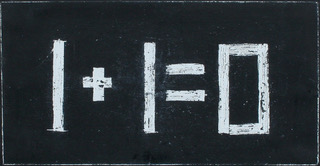
More than a year and a half ago, Gabriele Di Matteo, who owns a sixteen-volume Treccani encyclopaedia, began cutting images from the books and mounting them onto small handmade linen canvases. The selected images focus on three thematic areas: portraits of scientists, artists, poets, writers, politicians, and other historical figures; animals; and mathematical formulae. Each category corresponds to one of the primary colours, applied to the canvases through a plastic filter: blue for portraits, yellow for animals, and red for formulae. The installation is conceived as a form of score or text: long sequences of these small canvases compose an open structure. In dialogue with them, a selection of earlier works by the artist will also be presented, featuring invented or nonsensical formulae. In fact, 1+1=0 (1986) is a work based on an invented formula centred on the idea of zeroing, much like the project as a whole, in which the elements within the three categories are zeroed through the erasure of their context and horizon of meaning. As the curator, Lorenzo Madaro, explains in his text on the exhibition: “This project dedicated to the Treccani Encyclopaedia is not a celebratory tribute […]. At a time when digital culture, artificial intelligence, and mass distraction have persistently attempted to sideline the tactile relationship between the desire to know everything and the printed page as the site where this deep cultural drive is fulfilled, an installation such as this restores a direct confrontation not only between the artist and the process of developing the work, but also between us as viewers and the printed images, cut out and repositioned on the walls of the exhibition space.”
D.E.I., presented for the first time at WIZARD LAB, is an ongoing project in clear continuity with Di Matteo’s artistic research on the topics of the copy, reproduction and originality. It introduces a new layer of complexity to his earlier works by addressing the impossibility of compiling all knowledge, and how its interpretation and diffusion can be always open to new readings and breakthroughs. Through his artistic practice, Di Matteo brings these themes to the forefront by engaging in recombination and imagining new dialogues between disparate and previously disconnected elements.
Gabriele Di Matteo (Torre del Greco, Italy, 1957) Di Matteo reflects about the power and autonomy of the image and the persuasive force of art, still linked to the romantic myth. The utopian fascination resides in the attempt of reproducing it mechanically; the artist who repaints these canvases can only do so imperfectly, in full awareness of the impossibility of producing an identical copy.
Following his painting studies at the Fine Arts School of Naples, in 1985 Gabriele Di Matteo exhibited his work in Evacuare Napoli, curated by Achille Bonito Oliva, held at the Istituto Grenoble of Naples. The paintings he showed there echoed the language of the Neo-Expressionists but in an ironically theatrical key. As early as the following year, the artist operates a radical linguistic zeroing. As for 1+1=0, now part of the Museo Madre collection, the operated reset led Di Matteo to create works that triggered other mechanisms of reflection that were of a conceptual nature. In 1989, with the opera Cassa Contanti, he won the Saatchi & Saatchi award. On this occasion, his alter ego Armando della Vittoria intervened for the first time. Later in 1992, under the identity of Armando della Vittoria, Di Matteo founded the magazine E il Topo. The first issue of this artist-run magazine was presented together with the artists Piero Gatto, Franco Silvestro and Vedova Mazzei, this same year in Milan at Viafarini. During the following years Gabriele di Matteo produced great cycles of works such as La Vie illustrée de Marcel Duchamp 1993, Arafat 1995, The Blind Man 1998, History Stripped Bare 2000/2005, Le Peintre salue la mer 2005, Jackson Pollock Life 2009, China Made in Italy 2010. In 2002 the artist’s first retrospective exhibition was organized in France by the Frac Limousin, together with the Frac Bretagne at the Centre d’Art Le Grand Café in Saint Nazaire. Recently his works have been exhibited at the MAM (Musée d’Art Moderne of the Ville de Paris), at the ZKM In Karlsruhe, Germany, at the MAMCO in Geneva at Art Basel Unlimited and at the Perez Museum in Miami.
His work is part of private as well as of public collections such as MAMCO de Genève, MADRE Naples, Museo del 900 Milan, FRAC Limousin, FRAC Occitanie Montpellier, FRAC Bretagne, FRAC Rhône-Alpes, FRAC Arthothèque Nouvelle-Aquitaine, PAC Milan.
WIZARD LAB
Corso di Porta Ticinese, 87
20123, Milan